
Prince William Deed Types
Prince William County deeds all pass through the Circuit Court Clerk. The Clerk records land instruments in LRMS. A deed transfers an interest in real estate. Still, not everything labeled a deed is an ordinary sale. Some documents are related instruments that only look like deeds at a glance. A recorded document is never a title opinion, either. The table below sorts common transfer forms from the lookalikes. Those lookalike instruments often get mistaken for them.
| Deed Type | What It Does | Common Use |
|---|---|---|
| General warranty | Conveys the described interest with broad title covenants | Sale or transfer where those covenants are used |
| Special warranty | Limits covenants to matters arising during the grantor’s ownership | Some commercial or entity conveyances |
| Quitclaim | Transfers whatever interest the grantor holds | Family or title cleanup; not a promise of full title |
| Trustee or executor | Shows a transfer by a fiduciary with authority | Estate or trust administration and court sales |
| Commissioner’s deed | Records conveyance after a judicial sale | Tax-foreclosure confirmation trail |
A deed of trust secures a loan. It does not move the borrower's ownership to the lender. Assignments, satisfactions and releases can follow years later. Compare the grantor, the grantee, the legal description, the recording date and any cited references before deciding what actually changed.
Prince William’s 1732 Index
Land records here reach back to 1732. That is a remarkably deep trail for property research. Online deed images generally start in 1918. The plat index opens in 1794, with images also from about 1918. The cutoff between index and image is an access limit. It is not a hole in the county's history. When an old entry lacks a scan, write down the book and page. You can also note the instrument reference. The Clerk's Records, Research & Copy Center can then pull the right volume or film.
The Circuit Court Clerk's official LRMS access page lays out the remote index and image options. Occasional image access costs $0.50 per page plus a $2 Internet Convenience Fee. A signed remote subscription runs $240 per year. Courthouse public computers offer another route. Older material may call for staff help or an in-person archive visit.
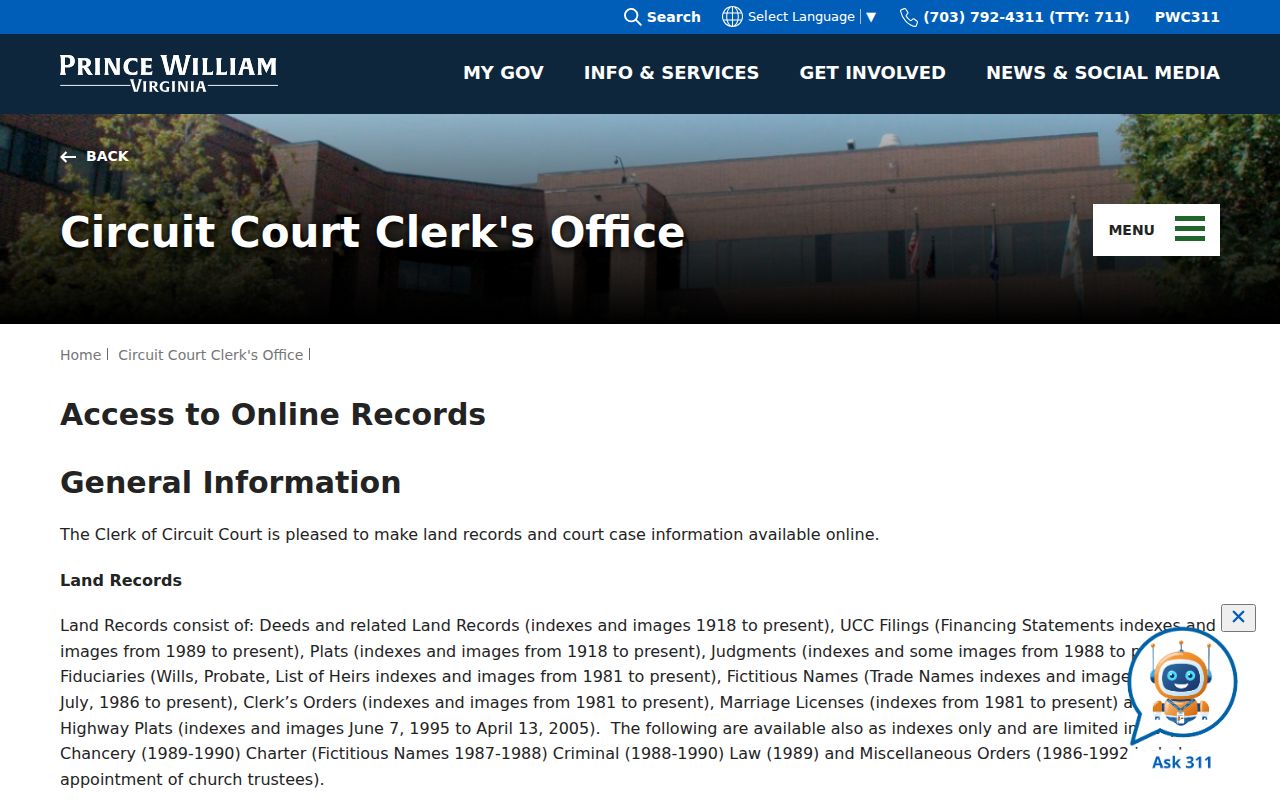
The index supplies names and instrument clues only. To read the full conveyance and legal description, you need the document image itself.
Search Prince William Grantors and Grantees
The grantor transfers an interest. The grantee receives it. Search both roles, because the name you know can appear on either side of a deed. A typical index hit gives a record reference and a recording date. It also lists the document type, the parties and sometimes consideration, parcel clues or an image link. Names are often indexed exactly as vested or signed. So a middle initial, a trust name or an estate label can decide whether your search succeeds.
- Search the known owner as grantee and narrow the deed results by date or record type.
- Read the instrument to identify the grantor and confirm the legal description.
- Search the prior grantor as grantee to locate that party’s acquisition.
- Repeat through earlier transfers, recording book/page references when images are unavailable.
- Grantor
- The party who conveys an interest in the instrument.
- Grantee
- The party who receives the interest described.
- Chain of title
- The linked sequence of recorded transfers for a parcel.
- Book and page
- A volume reference used to locate an older recorded item.
- Instrument number
- A clerk reference that identifies a later recorded document.
Common surnames need filtering. Narrow the results by instrument date, type, parcel clue and legal description before following any chain. One party may surface in a deed, a deed of trust, a release, a plat or a fiduciary record. Not all of those entries transfer ownership. Record the full reference and locality for each likely deed. Then read the instrument and any cited plat. Do this before treating a name match as proof of the same tract.
Prince William Clerk Record Dates
The Circuit Court Clerk keeps far more than warranty deeds. Its online and hard-copy catalog spans plats, deeds of trust, judgments, UCC filings, fictitious names, wills, fiduciary records, marriage licenses and clerk's orders. Each series starts at a different year. The land-record index begins in 1732. Wills index from 1734. Plats index from 1794. Online images vary too. Wills images start in 1989, fiduciary images in 1981 and judgment indexes in 1988.
The Clerk's coverage page separates those series. It also points visitors to the courthouse for older books and film, noting hard-copy material in Room 305. When you request a search, name the exact record series and year. "The deed archive" will not describe a will, a fiduciary file or a judgment index. Certified-copy fees are not published, so confirm the cost before ordering.
The clerk's record-availability table is the best starting point for coverage details and offline holdings.
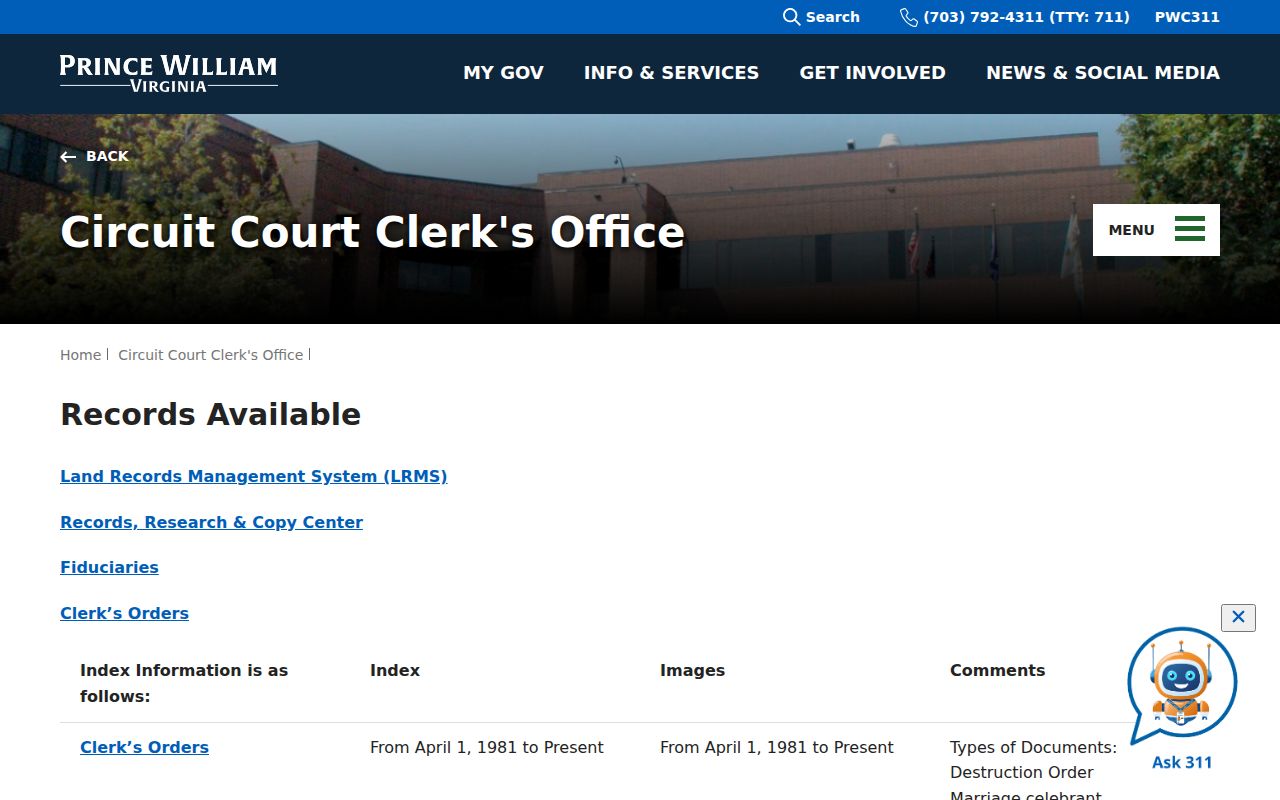
Let the listed years guide your route. They tell you whether to order a remote image, request microfilm help or consult a library finding aid.
Older Prince William Deed Books
For a deed older than the online image run, start with the free index. Copy the party names and the book and page reference. Copy the instrument type and the legal description exactly as written. Offline, the clerk holds hard-copy deed books and microfilm. RELIC keeps county-government records on microfilm plus historical maps, real-estate atlases and directories. The Library of Virginia has digitized Prince William chancery files from 1804 through 1951, with the richest share from 1831 to 1921.
A chancery case is not a deed. Its pleadings and exhibits, though, can explain an inheritance, a boundary fight or a title claim. Use RELIC's catalog together with the clerk's index when an old transfer names a subdivision or tract that no longer matches today's streets. Search historic locality names too: the county seat moved from Brentsville to Manassas in 1894. The modern independent-city boundaries came later still.
Prince William Deeds of Trust and Releases
Deeds of trust and their follow-up instruments live in LRMS alongside the other land records. Search by either party or by parcel description. The security instrument names the borrower or grantor, the lender or beneficiary, and the trustee. It records the principal amount, parcel references, and recording date. A release, satisfaction, or reconveyance comes later. It clears the lien, but the older entry can stay in the index. Follow the related entry and its date before assuming a lien still stands. Judgments are indexed from January 1, 1988. The Clerk cautions that releases filed before November 17, 2000 often appear only in related notes. Later releases get separate entries. A lis pendens may link the two. Read the filed order or the deed itself. See what it did to the property.
Prince William Deed and Court Search
A land record and a court docket answer different questions. For the court side, the official Prince William case-search instructions point to the Virginia Online Case Information System. Choose Prince William County Circuit and the Civil division. Then query by name, case number, or hearing date. Online case summaries start July 1, 1989. A case page can display parties, hearings, disposition, and tabs for pleadings or orders. Juvenile, adoption, and sealed matters are excluded. Current documents are often scanned. Older files may need a courthouse terminal or an archived file request. Tax foreclosure works differently. The Clerk does not keep the auction list. The County Attorney publishes tax-sale information. Check the notice and court order. Then find the commissioner's deed or the later recorded transfer.
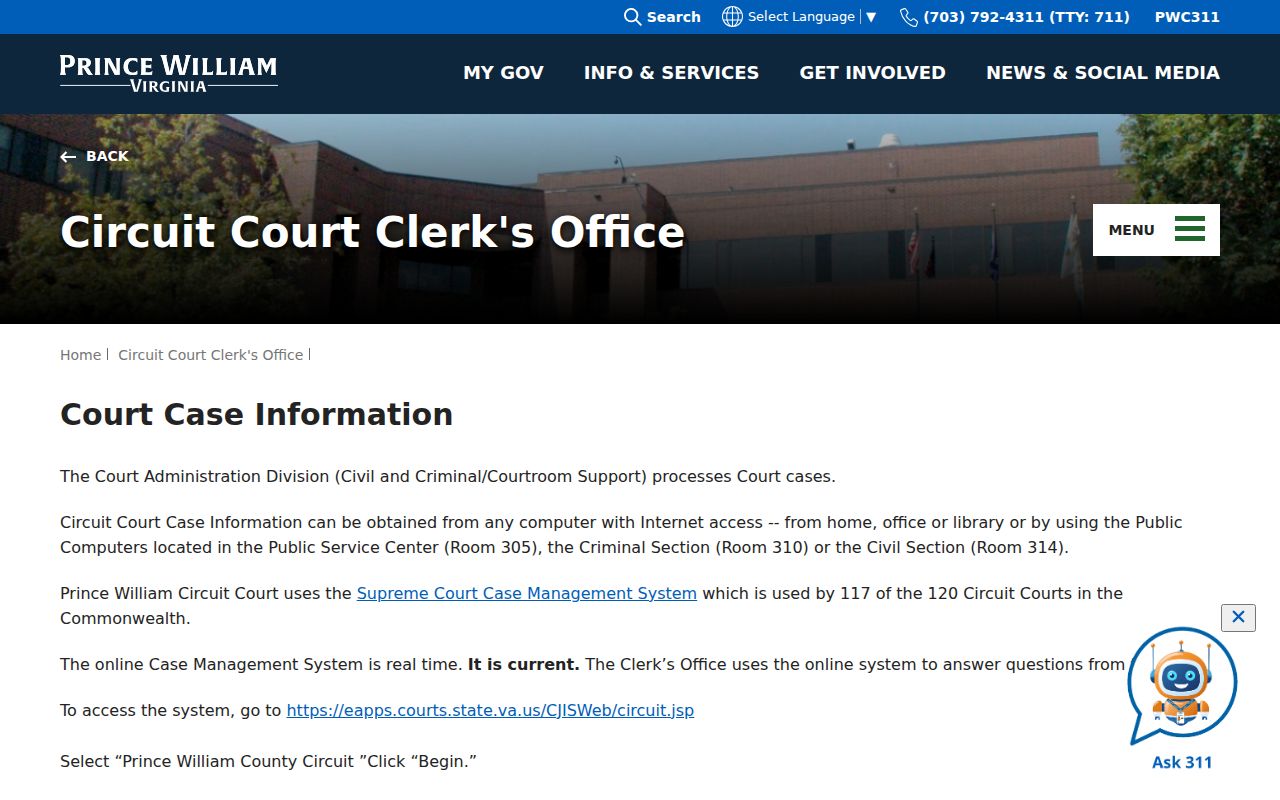
A docket match still needs confirmation. Compare the case against the parcel, legal description, and land-record reference, because a shared name alone does not prove the case concerns the property.
Obtain a Prince William Deed Copy
Start with the free LRMS index. Identify the exact instrument before paying for an image. Occasional users can buy remote images at the published per-image price plus a convenience fee, and a $240 subscription is the other remote option. Public terminals at the Public Service Center and court sections offer in-person access. Older books, microfilm, certified copies, and records that are not available online go through the Records, Research & Copy Center. When you contact the Clerk, give both parties, the approximate recording date, the deed type, and a legal description or parcel clue. Ask whether the copy must be certified. Ask whether the cited image is complete. Confirm the clerk's fee schedule as well. Keep the source citation with the document you save, since you may need it again. A downloaded image is not a title report.
Recorded, not guaranteed. A Prince William County index reveals instruments in the record, not every possible interest or an opinion that title is clear. A title professional reviews the chain and exceptions.