
Prince William County Tax Record Fields
Two records anchor any county property tax search. Real Estate Assessments publishes the owner of record, legal description, sale data, and value fields. Tax Administration's taxpayer portal carries the account side: bills, payments, and delinquency. Every value needs its tax year. Every bill needs its due date and payment status. Because both records hang on the parcel, save the GPIN or account number before you switch systems.
| Field | What It Shows | Where |
|---|---|---|
| Land value | Assessed land component for the stated tax year | PublicAccessNow |
| Building value | Improvement component, separate from land | PublicAccessNow |
| Total assessed value | Annual roll figure used in the tax process | Real Estate Assessments |
| Sale date and price | Reported prior transaction, not today’s bill | Assessment card and deed |
| Bill and payment status | Amount due, paid or delinquent account | Taxpayer portal |
Virginia law requires assessment at fair market value. Still, an annual tax value is not a private appraisal and not a sale price. The assessor weighs sales comparison, cost, and income approaches. Tax Administration then applies the rate and account rules to bill the parcel. Need a plain-language breakdown of the three value measures? See the Prince William property-value explanation.
Prince William’s Annual Assessment Roll
Prince William County assesses real property every year, and the tax year follows the calendar. Values take effect January 1. The assessment office also inspects properties periodically to confirm descriptions. Its PublicAccessNow application displays land and building components, total assessed value, and the legal description. It also shows the owner field and sales data. One caution: the displayed owner can lag a recent deed. Recording a deed and updating the roll are separate steps.
For any roll question, keep the GPIN, account or RPC number. Also keep the address, the tax year, and the exact field label. A value that looks wrong deserves a comparison first. Check the physical description, the improvements, and recent comparable sales before contacting the office. The ownership field can lag after a transfer. The newest recorded deed settles it. The portal is the assessment record, not the deed index.
Find a Prince William Tax Bill
Pull the assessment card first. Then take that account or parcel number straight to the taxpayer portal that Tax Administration links to. The bill itself lays out everything worth checking. You'll see the billing period, each installment, the due date, the current balance, and whether payment has posted. Payment choices and any channel fees vary by method. Need a person instead? Call taxpayer services at 703-792-6710, or visit 5 County Complex Court in Woodbridge or 7987 Ashton Avenue in Manassas, where the county lists its offices.
- Open the official county taxpayer portal and enter the account or parcel details requested.
- Check each installment, the due date, balance and payment status separately.
- Compare relief or use-value classifications on the assessment record with the bill account.
- If delinquent, confirm the next step with Tax Administration and the County Attorney’s official sale information.
- Assessed value
- The county’s annual value for tax administration, shown with its year.
- Tax bill
- The account charge for a tax period and installment.
- Use-value assessment
- A qualifying land classification taxed by use rather than market value.
- Tax lien
- A recorded or statutory claim tied to unpaid tax, subject to its own release path.
Prince William Payment Records
The county payment portal and PublicAccessNow serve different jobs. PublicAccessNow is the assessment application. Tax Administration links tax.pwcgov.org for taxpayer accounts. The portal's entry screen can vary. Some account details may require information from a bill. Keep receipts and confirmation numbers with the tax year and parcel account. That habit matters most when a payment lands close to a due date.
The official Prince William taxpayer portal is the online path. When a lookup will not show a needed field, call Taxpayer Services rather than guessing a balance from the assessed value. Questions about assessment components or sale history go back to Real Estate Assessments. A tax account can confirm the bill status shown there. It cannot establish current title.
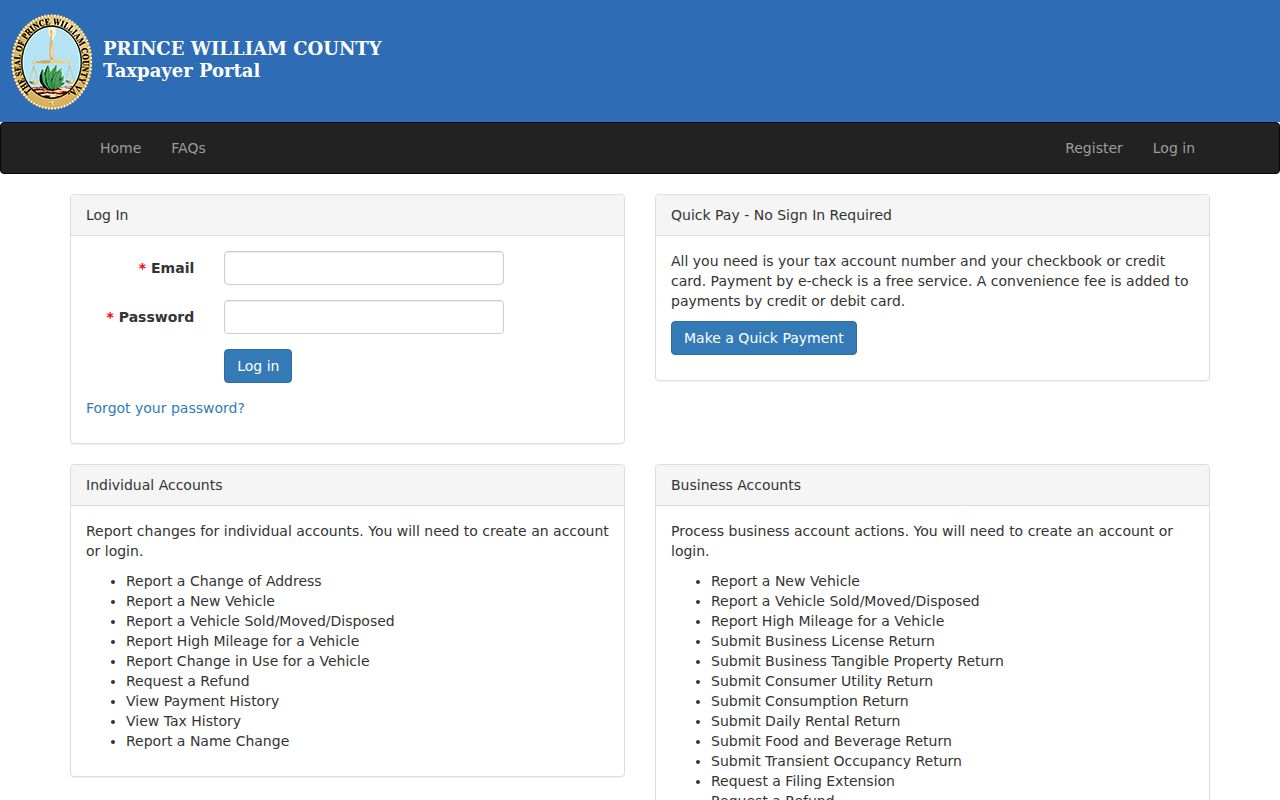
Keep the account result and receipt as proof of your payment inquiry. Then confirm any unresolved balance directly with the county custodian.
Prince William 2026 Appeal Dates
The county's 2026 calendar set June 1 as the administrative appeal deadline. July 1 was the Board of Equalization deadline. Published guidance also allows a circuit-court appeal within three years. Those dates have passed. For a later tax year, check the current Real Estate Assessments calendar. Do not carry old deadlines forward. The 2026 notice reported a 6.2 percent aggregate assessment increase. That figure excluded new construction and improvements. The proposed rate was $0.906 per $100. That rate was proposed only.
Administrative review, a Board of Equalization hearing, and a court appeal are three distinct routes. A prior-year assessment does not reopen just because a later sale differs. The county's assessment page lists its current review channels and forms. Preserve the notice date and the applicable deadline when building a value case.
Prince William's official Real Estate Assessments page is the source for current appeal routes. It also carries assessment updates.
A sales comparison works best when the parcel, sale date, and property traits closely match the appealed assessment.
Prince William Board Evidence
The 2026 Board of Equalization form asks for the basics first. That means the tax year, ownership name, and property address. It also includes the RPC, account number, or GPIN. Evidence supporting the claim travels with it. An authorized representative files an original notarized Letter of Authorization. A company representative adds a corporate resolution. The form also states a presumption worth noting. The assessor's value stands unless the taxpayer rebuts it. Rebuttal requires proof of overvaluation or nonuniform assessment.
Hearings run September through December. Expect notice about two to three weeks ahead. A valuation analysis comes roughly two weeks out. Volume means no rescheduling. A written statement can be submitted by noon on the hearing day. A decision notice should arrive by December 31. Before sending any packet, check the current form and instructions for that tax year.
Prince William Use-Value Land
Qualifying agricultural, forestal, horticultural, or open-space land can be assessed on its use. Full market value does not apply to that land. Buildings stay at market value. Revalidation is required every sixth year, with the next mailing scheduled for fall 2026. A new application is generally due within 30 days after assessment notices go out. The fee runs $10 per new or revalidation application, and taxes must be current.
Changing the use, rezoning for something more intensive, or subdividing can trigger rollback tax. The county applies a lookback covering the current year and the five preceding complete tax years. It charges the difference between market and use value plus interest. So a low land figure may reflect a classification, not a market appraisal. It can also carry a land-use obligation. Before assuming the classification transfers unchanged, check any recorded easement and land-use instrument.
Prince William Delinquency and Sale
Real-estate taxes in Prince William County are billed in two installments. The first-half 2026 due date was July 15, 2026. A delinquent balance attaches to the tax account. It is not a map layer. It also does not prove a judicial sale has finished. The County Attorney's page describes the tax-foreclosure auction process and offers an auction-flier mailing list. Prince William County also states this plainly. The Circuit Court Clerk does not maintain the foreclosure auction list.
For a distressed parcel, line up several records side by side. Compare the Tax Administration account, the County Attorney notice, the Circuit Court case summary, and LRMS judgments and lis pendens. Include any commissioner's deed too. A judicial tax foreclosure can run six months to more than a year. The timeline depends on ownership and lien complexity. The owner gets a notice period. There is also a chance to redeem or pay before the sale proceeds. A private deed-of-trust sale may follow a different process. See the official County Attorney foreclosure auction information for the current notice route.
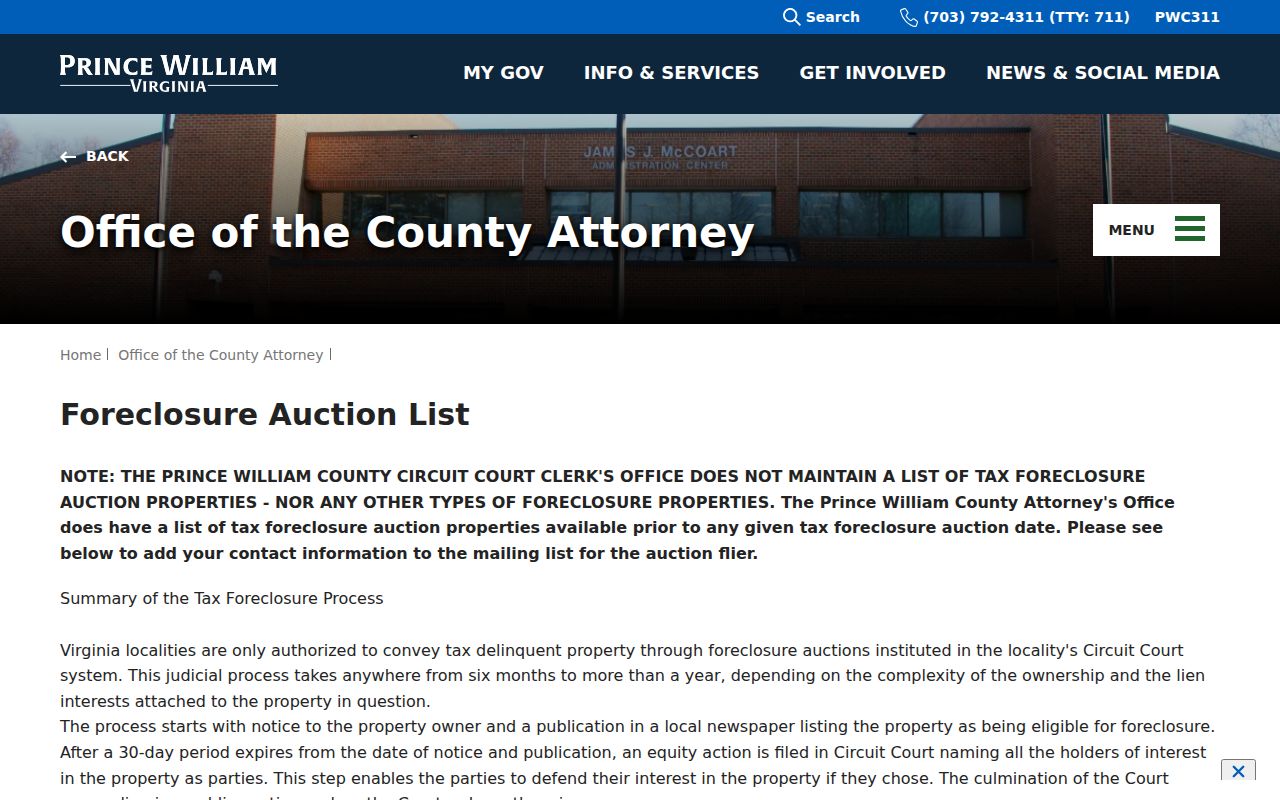
After an auction, verify the court order and the recorded deed. A mailing-list flier signals a process under way, not proof of a completed transfer.
Appeal a Prince William Assessment
An assessment appeal challenges the county's valuation of the parcel. It does not dispute the tax bill's payment status. Gather the assessment notice, property facts, and photos or correction evidence. Also collect comparable sales with dates and parcel descriptions. A representative needs whatever authority the county form requires. After an administrative review, the Board of Equalization offers a hearing route. A court filing carries its own deadline and procedure.
Appeal window. The 2026 administrative and Board deadlines were June 1 and July 1, respectively. Those dates have passed; check the county’s current calendar before relying on a deadline.